
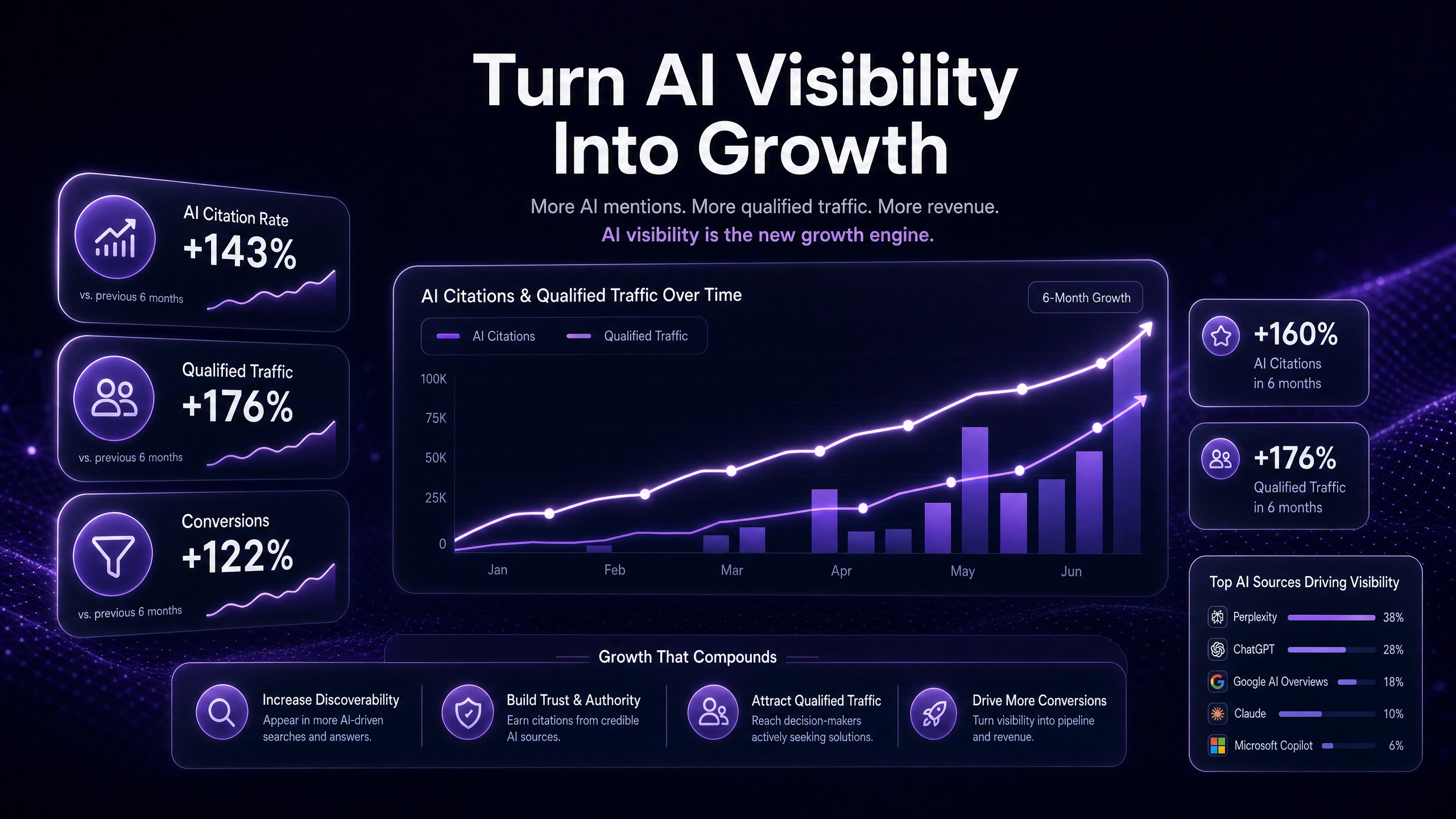
Does generative engine optimization work? Controlled research shows that some content interventions can change measured source visibility within specific experimental settings. That supports a cautious yes: GEO can influence visibility, but current evidence does not establish a universal method, durable cross-platform gains, or guaranteed traffic and revenue outcomes.
A useful GEO program improves the conditions that can make a brand easier to discover, understand, verify, select, and represent accurately. It then tests whether those improvements appear repeatedly across a defined prompt cohort while keeping citation, answer influence, and business impact separate.
The Short Answer: GEO Is Probabilistic, Variable, and Measurable
AI answers contain stochastic variation, but the outcomes are not purely arbitrary. Their probability distribution is shaped by source availability, topical relevance, retrieval and reranking, context allocation, model policies, prompt wording, source quality, and generation settings.
GEO works on inputs that publishers and brands can influence: technical access, topic alignment, answer structure, evidence quality, entity consistency, and external corroboration. These changes cannot guarantee a citation on a particular run. They can increase the likelihood that relevant content is retrieved, selected, cited, or used in an answer across repeated observations.
For the relationship between established search foundations and generated-answer visibility, the SEO-to-GEO guide explains why GEO extends rather than replaces SEO.
What Current GEO Research Actually Shows
The foundational GEO: Generative Engine Optimization study by Aggarwal and coauthors was published as a peer-reviewed paper at KDD 2024. It introduced GEO-bench, tested content interventions across a large benchmark of queries and domains, and reported visibility improvements of up to 40% within its experimental setting. Strategies involving citations, relevant quotations, and statistics performed well in parts of the benchmark, but the authors also reported substantial variation by domain.
That result does not mean every website can increase ChatGPT or Perplexity citations by 40%. The experiment measured visibility under defined benchmark conditions, and the tested source was already available within the system's fixed context. It demonstrates that changing already-retrieved content can affect measured visibility; it does not establish a universal effect on organic discovery, long-term citations, traffic, or revenue.
A 2026 critical survey of GEO research reviewed 45 studies and proposed a multistage evidence framework. This work is an arXiv preprint, not a completed peer-reviewed consensus. Its authors found that terminology, metrics, and evidence standards remain heterogeneous, and concluded that the reviewed literature does not yet show a stable, longitudinal, cross-platform causal effect on organic discoverability or downstream behavior.
The evidence therefore supports GEO as a testable optimization discipline, not as a guaranteed ranking formula. Controlled studies can establish effects inside their tested environments. Commercial GEO case studies can add useful operational evidence, but they require transparent baselines, interventions, raw observations, and limitations before their results can be generalized.
Why AI Citations and Answer Use Vary
Retrieval Differences
An AI platform may use different documents for two related requests. Search activation, query interpretation, freshness, index state, retrieval, reranking, context allocation, and platform-specific policies can change which evidence is available to the model. A single screenshot is therefore weak evidence; repeated sampling across a stable prompt cohort is more informative.
Model and Prompt Variation
Small wording changes can alter intent and source relevance. Model versions, search modes, response policies, and generation settings can also change. A sound measurement program records the exact prompt, paraphrase family, platform, mode, answer, citations, and competitor appearances instead of reducing every observation to one unexplained score.
Source Freshness and Ecosystem Changes
Platforms revisit and reprocess sources at different times. A newly published page may not enter every retrieval workflow immediately, while an older third-party source can continue shaping an answer after the brand has updated its own site. Competitor publishing, engine updates, and source-index changes can also move results without any change to the tested page.
Keep Four GEO Outcomes Separate
A page can be retrieved without being cited, cited without materially shaping the answer, or visible without producing business traffic. A 2026 preprint, From Citation Selection to Citation Absorption, proposes measuring visible source selection separately from whether a source contributes language, evidence, structure, or factual support to the answer. Its findings are descriptive and have not completed peer review, but the distinction is useful for preventing citation counts from being treated as proof of answer influence.
| Stage | What It Measures |
|---|---|
| Discoverability | Whether a page or brand enters a relevant retrieval or source pool |
| Citation Selection | Whether the page is shown as a visible citation |
| Citation Absorption | Whether the page materially influences facts, language, evidence, or structure in the generated answer |
| Business Outcome | Whether the exposure produces referral traffic, qualified visits, leads, revenue, or another commercial result |
Each stage needs its own evidence. A citation is not automatically an absorbed source, and either outcome can occur without a measurable commercial effect.
What Controlled Evidence and GEO Case Studies Can Prove
Controlled evidence isolates a defined intervention under documented conditions. Stronger GEO tests use a stable prompt cohort, repeated runs, comparable engines and modes, a clear observation protocol, and a control group or staggered rollout. The result should be stated at the level the design supports: an association, a within-test effect, or a broader causal claim.
A commercial case study may show that visibility changed after a coordinated set of technical, content, and external-source improvements. It usually cannot prove that one edit caused one AI answer, because engines, competitors, indexes, and prompts may also change. The GEO content platform review provides additional context for evaluating what software measurements and case studies can and cannot demonstrate.
GEO Tactics and Their Current Evidence Levels
The practices below do not share the same evidence strength. Some are participation requirements, some have controlled support after retrieval, and others remain operationally sensible but causally under-tested across platforms.
| Tactic | Current Evidence Level | Safe Conclusion |
|---|---|---|
| Technical Accessibility | Foundational requirement | Content that cannot be reliably accessed cannot participate in some retrieval workflows |
| Topical Relevance | Relatively strong rationale and research support | Content must closely match the prompt and retrieved context |
| Clear, Evidence-Dense Passages | Controlled and descriptive support | Clear facts, definitions, comparisons, and methods can improve content usability after retrieval |
| Citations, Statistics, Relevant Quotations | Supported in the KDD 2024 benchmark | These interventions can improve measured visibility in some domains and settings |
| Entity Consistency | Strong operational rationale, limited causal evidence | Consistent brand facts reduce conflict but do not guarantee retrieval or citation |
| Third-Party Validation | Plausible and frequently observed | Independent sources can strengthen corroboration, but effects vary by source ecosystem and prompt |
| Structured Data | Useful technical hygiene | Structured data supports machine-readable consistency but is not proven to cause AI citations on its own |
How GEO and SEO Work Together
GEO does not eliminate SEO. Crawlability, indexation, site architecture, internal links, useful content, authority, and brand demand can influence whether information becomes available to search and retrieval systems.
The measurement layer differs. SEO commonly evaluates rankings, impressions, clicks, and conversions. GEO adds prompt-level discoverability, mentions, citations, recommendation context, answer accuracy, source selection, citation absorption, and competitive share of voice. Neither measurement set should be used as a substitute for revenue evidence.
A Controlled Measurement Framework for Variable Outputs
Define the test before changing content. Build a core prompt cohort covering branded, category, comparison, alternative, use-case, and purchase-evaluation questions. Add controlled paraphrase variants so the test does not depend on one exact wording. Select the engines, model or search modes, regions, languages, and competitor set.
Establish a baseline with repeated runs and retain raw answers, visible citations, timestamps, and validity status. Where possible, keep one comparable topic cluster unchanged as a control and apply the intervention to a separate test cluster. A staggered rollout is stronger than changing the entire site at once because the unchanged or later-treated cluster provides a reference for normal platform volatility.
After the intervention, continue sampling both groups under the same conditions. Compare absolute counts, rates, differences between test and control, and run-to-run volatility. Inspect the answer itself to determine whether a visible citation actually supports the generated claims.
PallasAI Insights supports investigation by breaking the overall AEO score down by AI platform, topic, time trend, and response detail. Teams should still preserve the test conditions and raw evidence needed for a controlled comparison; Insights does not replace experimental design.
PallasAI Content turns an approved content opportunity into a fact-backed draft using verified brand context, keeps human review as the final gate for material claims, and connects the published asset to later recommendation measurement.
A Practical GEO Test Plan
1. Select one commercially meaningful topic cluster with a credible reason for the brand to appear.
1. Build a set of core prompts and controlled paraphrase variants for that cluster.
1. Choose a comparable control cluster and define the intervention group.
1. Sample both groups repeatedly under the same engines, modes, regions, and languages.
1. Save exact prompts, raw answers, visible citations, competitor mentions, timestamps, and valid or failed run status.
1. Apply one clearly documented group of changes to the intervention cluster while leaving the control unchanged.
1. Record content publication and indexing signals, along with relevant external-source changes.
1. Continue sampling after the updated content becomes accessible and has had an opportunity to be rediscovered; do not impose one universal waiting period across platforms.
1. Compare counts, rates, volatility, citation absorption, and test-versus-control movement. Expand only after the improvement repeats across prompts and observations.
For an initial inventory of access, entity, content, and visibility issues, a PallasAI AI Visibility Audit can provide a baseline. The audit result should be treated as diagnostic input, not proof that a later intervention caused a particular outcome.
Common GEO Misconceptions
GEO should guarantee citations
No optimization process controls every generated answer. GEO can improve tested conditions and probabilities, not guarantee source selection on every run.
AI answers vary, so measurement is useless
Variability is a reason to use repeated observations, prompt variants, controls, and raw-answer review. It is not a reason to treat one favorable or unfavorable output as conclusive.
GEO replaces SEO
GEO extends search strategy into generated-answer environments while relying on many of the same technical, content, entity, and authority foundations.
More content automatically produces more AI visibility
Publishing volume is not the same as improving discoverability, evidence quality, citation selection, or answer influence. More pages can add noise if they repeat existing material or conflict with approved brand facts.
Frequently Asked Questions
Does generative engine optimization work?
Current evidence supports a cautious yes within defined conditions. Content interventions can affect measured visibility or source use after retrieval, but no universal method has been shown to produce durable cross-platform citations, traffic, or revenue.
How does generative engine optimization work?
GEO improves controllable inputs such as access, relevance, answer structure, evidence quality, entity consistency, and external corroboration. Teams then test whether those changes affect discoverability, source selection, citation absorption, or business outcomes across repeated observations.
Why do AI citations change between runs?
Retrieval, prompt interpretation, model behavior, search mode, source freshness, context allocation, competitor activity, and stochastic generation can all change the sources or language used in an answer.
How should GEO case studies be evaluated?
Look for a defined baseline, documented intervention, stable prompts and variants, repeated sampling, raw answers, visible citations, a control or staggered rollout, human validation, and causal claims that match the study design.
How do you measure GEO?
Measure discoverability, citation selection, citation absorption, and business outcomes separately. Record test conditions and raw evidence, then compare repeated patterns across test and control groups rather than relying on one composite score.
Should GEO replace SEO?
No. SEO supports technical discovery, indexation, authority, traffic, and conversion. GEO adds measurement and optimization for generated-answer environments, but it does not remove the need for established search fundamentals.
Build GEO Around Testable Improvements
The evidence does not support treating GEO as a guaranteed ranking system. It supports a narrower and more useful conclusion: defined content interventions can change measured visibility or source use in specific settings, and those effects can be investigated with repeated, controlled observations.
Teams should improve inputs that make information accessible, relevant, clear, verifiable, and consistent, then test each stage separately. GEO becomes credible when its claims remain proportional to the evidence and its measurement distinguishes source discovery, visible citation, answer influence, and commercial results.