
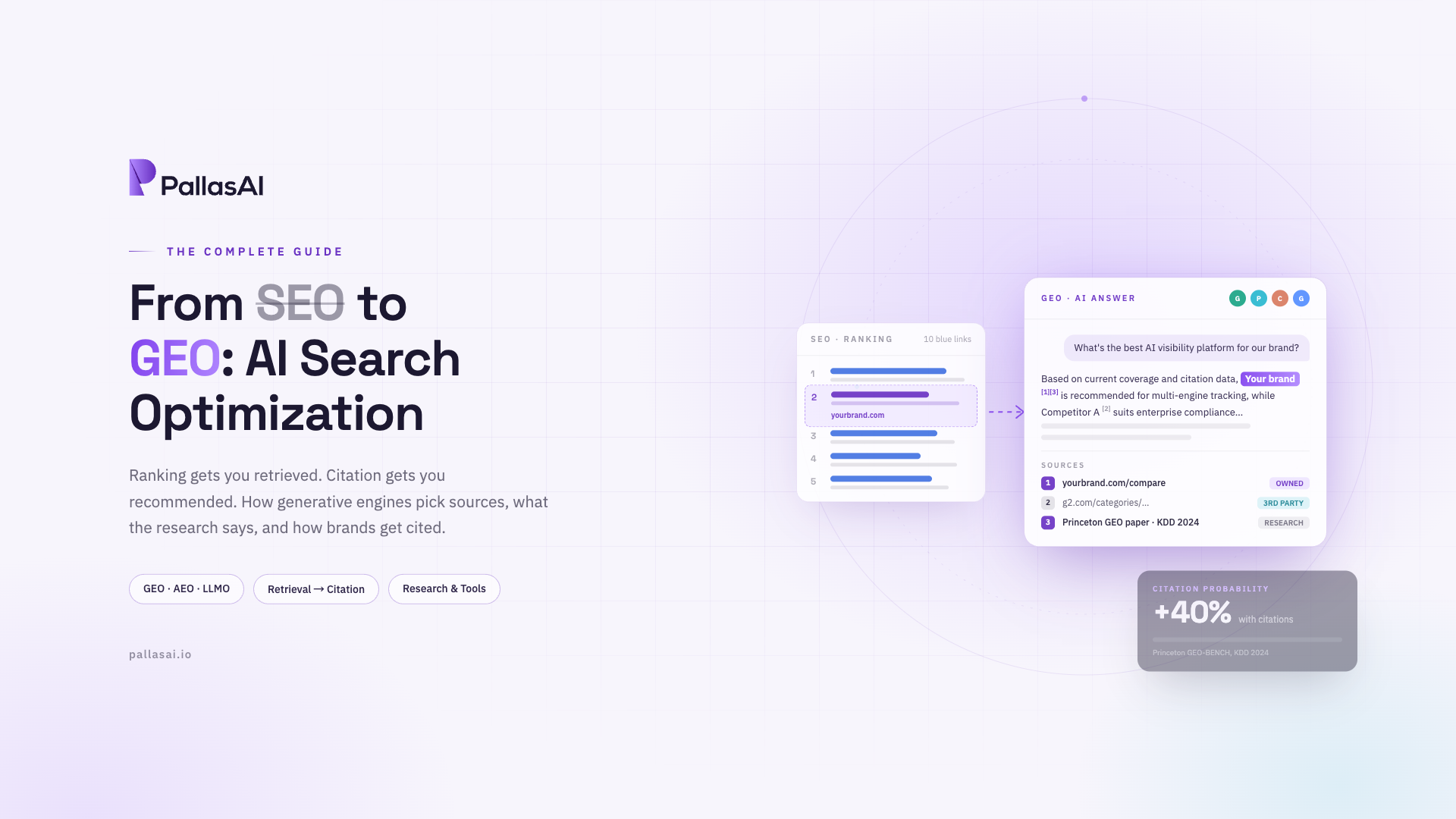
AI search optimization improves the conditions that help a brand's information become accessible, retrieved, understood, cited, and represented accurately in AI-generated answers. It combines durable SEO foundations with answer-ready content, consistent entity information, credible external evidence, and repeated measurement.
The discipline is broader than adding a few citations or rewriting pages for a particular chatbot. Different AI products use different combinations of search indexes, proprietary crawling, licensed data, model knowledge, live retrieval, and user-provided context. No universal formula guarantees inclusion. A defensible program therefore improves the underlying source system and tests results across the engines, markets, and questions that matter to the business.
What AI Search Optimization Is
AI search optimization is the practice of improving how an organization is discovered and represented in search experiences that generate direct answers. It covers the technical ability to access a source, the relevance of that source to a question, the quality and clarity of the evidence, the consistency of the entity being described, and the authority signals available beyond the organization's own website.
Success is not a single ranking position. A page may be retrieved without appearing as a visible citation, cited without materially shaping the answer, or used by a system without producing a measurable visit. Teams should separate these outcomes rather than treating every mention, citation, click, and lead as the same event.
SEO vs AEO vs GEO vs LLMO
These terms overlap, but they are not interchangeable.
| Term | Primary Focus |
|---|---|
| **SEO** | Organic discovery, crawlability, indexation, rankings, and qualified clicks |
| **AEO** | Becoming a direct answer across featured snippets, voice systems, and answer experiences |
| **GEO** | Visibility, citation, and representation inside generative-engine responses |
| **LLMO** | The broader way LLM-based systems understand, retrieve, and represent an entity |
SEO remains foundational because accessible, well-organized, authoritative pages are easier for search and retrieval systems to use. AEO predates generative AI and focuses on direct-answer formats. GEO concentrates on how generative systems select, synthesize, and cite sources. LLMO is a wider practitioner label that can include retrieval, entity representation, brand facts, and model-facing content systems.
The practical takeaway is simple: do not replace SEO with GEO. Extend the same source quality, technical hygiene, and user-value standards into answer systems that may summarize the information before a user visits the site.
Retrieval, Selection, and Citation
AI visibility can be examined as a sequence rather than a single score:
1. Access: Can the relevant system fetch and parse the source?
2. Retrieval: Does the source enter the candidate set for the question?
3. Selection: Is the source chosen for use in the generated response?
4. Citation: Is the source displayed to the user as a visible reference?
5. Answer influence: Do its facts, language, or structure materially shape the answer?
6. Business outcome: Does the visibility contribute to qualified visits, demand, leads, or revenue?
A weakness at one stage can limit the next, but the stages do not form a guaranteed funnel. Improving crawlability does not guarantee retrieval. Retrieval does not guarantee a citation. A citation does not prove that the answer was influenced mainly by that source, and none of these outcomes guarantees commercial impact.
For a focused discussion of citation variability and controlled testing, see what current GEO evidence supports.
How AI Search Engines Find and Use Sources
AI answer products do not all use the same architecture. Depending on the product and mode, an answer may draw from model knowledge, search results, proprietary indexes, licensed sources, live web retrieval, or supplied context. Strong SEO foundations improve accessibility and discoverability, especially when an experience relies on web search or indexed sources, but no universal organic-ranking threshold guarantees inclusion.
Query Fan-Out and Retrieval
Some AI search systems use query fan-out: they issue multiple related searches across subtopics or data sources to assemble an answer. Google publicly describes query fan-out for its AI search features, but platforms do not disclose a universal ranking formula, result count, fusion method, or inclusion threshold.
The safe optimization lesson is not to chase invented cutoffs. Build complete topic coverage around real buyer questions, make each page's purpose clear, and ensure important claims can be found in readable text. A source may be discovered through several related retrieval paths, so coherent internal architecture and precise topical relevance matter more than trying to reverse-engineer one undisclosed score.
Citation and Synthesis Signals
After retrieval, a system still has to decide which sources are useful for the answer. Relevance to the prompt, factual clarity, source quality, recency where appropriate, entity consistency, and the availability of evidence can affect usefulness. The importance of each factor varies by platform, query, model, and source pool.
The peer-reviewed KDD 2024 GEO study reported visibility improvements of up to 40% within its benchmark setting. Citation addition, statistics, and relevant quotations performed well in parts of the benchmark, but results varied by domain. The study does not establish a universal 40% gain for citation addition, nor does it prove better organic retrieval, traffic, or revenue in live commercial environments.
This distinction matters. Controlled research can show that changing already-available content affects measured use in a defined setting. It cannot by itself establish that the same edit will be discovered, selected, and cited consistently across ChatGPT, Google, Perplexity, Gemini, Claude, or future model versions.
Technical Foundations
Technical SEO is not separate from AI search optimization. It determines whether important information can be accessed, interpreted, and associated with the correct entity. Teams should begin with the same basics that support conventional search, then test the specific access paths used by the answer engines in scope.
Crawlability and Indexation
Important pages should return stable status codes, expose meaningful content in rendered HTML, use consistent canonical signals, and avoid accidental blocking through robots directives or authentication walls. Redirects should preserve destination relevance, sitemaps should identify current canonical URLs, and essential evidence should not exist only inside images, videos, or interactions that a crawler cannot reliably process.
Indexation is useful evidence, not a universal prerequisite for every AI system. Some products use their own crawlers or licensed data. Others depend heavily on search indexes. The correct test is whether the systems relevant to the audience can access the authoritative source and whether brand-critical facts are presented in a stable, machine-readable form.
A free PallasAI AI Visibility Audit can provide an initial diagnostic view of access, recommendation, and factual-accuracy issues. It should be treated as one input to investigation, not as proof that every platform can crawl or cite a page.
Structured Data and Entity Clarity
Structured data can reinforce machine-readable facts about an organization, product, article, author, price, review, or event when the markup matches visible page content. It is useful technical hygiene, but it is not proven to cause AI citations on its own.
Entity clarity also depends on consistent naming, descriptions, relationships, and factual claims across owned pages and credible external sources. Product names, category terms, executive identities, pricing facts, and feature claims should not conflict across the site, documentation, profiles, review pages, and partner listings. Schema cannot repair a contradictory source ecosystem; it can only express the facts the organization has made consistent.
Content Optimization for AI Answers
Content for AI answers should still be written for people. Optimization means making useful evidence easier to locate, verify, and interpret, not reducing every page to a formula. The objective is to answer a well-defined question with enough context for a reader and enough clarity for a retrieval system.
Answer-First Structure
When a question has a direct answer, place a concise response close to the relevant heading, then provide the context, evidence, exceptions, and examples the reader needs. Use descriptive headings, short paragraphs where appropriate, and tables or lists only when they improve comparison or comprehension.
Answer-first does not mean every page must begin with a one-sentence verdict. Complex topics may require definitions, scope, or safety qualifications before a useful answer is possible. Structure should follow the user's decision, not an arbitrary word count or template.
Evidence and Source Quality
Material product, pricing, performance, legal, medical, and comparison claims should be verifiable. Prefer primary research, official documentation, first-party data with a disclosed method, and credible independent sources. Link the claim to the source directly instead of adding unexplained numbered references.
Statistics and quotations should earn their place. Record the publication date, sample, market, method, and limitations when they affect interpretation. Do not convert a benchmark maximum into a universal promise, a correlation into causation, or a vendor claim into independent evidence.
Topic Coverage
Strong topic coverage answers the central question and the supporting questions required to act on it. It does not mean publishing many near-duplicate pages. Map each page to a distinct intent, connect related pages through useful internal links, and consolidate overlapping content when several URLs compete for the same question.
Topic coverage should also reflect the language customers use. Product terminology, category labels, and buyer questions need consistent definitions. For B2B examples, this guide to earning citations in ChatGPT and Perplexity shows how evidence and answer structure fit a narrower commercial context.
Authority Beyond Your Website
Owned content explains the brand's position, but users often ask AI systems for comparisons, reviews, recommendations, and independent validation. In those settings, credible third-party evidence can be as important as the website itself.
External authority may come from reputable editorial coverage, research citations, expert commentary, partner pages, industry directories, customer evidence, documentation communities, and reviews with transparent provenance. The goal is not to manufacture mentions. It is to make accurate information available in the sources an audience already trusts.
Monitor contradictions as carefully as positive coverage. Outdated pricing, old product names, inaccurate descriptions, and unsupported claims on external pages can shape an answer even when the owned site is correct. A useful program identifies which sources recur in answers, prioritizes material inaccuracies, and pursues corrections or stronger evidence without assuming that any one placement guarantees selection.
For a diagnostic workflow, see why a brand can remain invisible in AI search.
Measurement and Testing
No single reporting system covers visibility across every AI answer platform. Google reports its AI search features within Search Console's Web Performance data, while many standalone assistants do not provide comparable first-party exposure reporting. Cross-platform measurement therefore requires a documented test design and preserved raw evidence.
Use a stable prompt cohort that reflects priority buyer questions. Add controlled paraphrase variants to measure sensitivity to wording. Record the exact prompt, engine, model or search mode when visible, market, region, language, date, raw answer, cited URLs, brand and competitor mentions, failed runs, and source changes. Repeat sampling rather than selecting one favorable screenshot.
Keep the outcome layers separate:
• Discoverability: Did the page or brand enter a relevant source pool?
• Citation selection: Was a page shown as a visible citation?
• Answer influence: Did the source appear to shape the facts, framing, or language?
• Business outcome: Did the activity contribute to qualified visits, demand, leads, or revenue?
Where possible, use an intervention group and a comparable control group. Change one defined variable or tactic in the test cluster while leaving the control cluster unchanged. A staggered rollout provides a better reference for normal platform volatility than changing the entire site at once. Even then, treat before-and-after movement as evidence to investigate, not automatic proof of causation.
PallasAI Insights can support investigation by breaking visibility down by AI platform, topic, time trend, and response detail. Teams should still preserve the test conditions and raw evidence required for a controlled comparison.
A Step-by-Step AI Search Optimization Framework
1. Define priority buyer questions. Select questions tied to real decisions, not only high-volume informational prompts.
2. Establish a repeated baseline. Run a fixed core prompt cohort and controlled paraphrases across the relevant engines, modes, markets, and languages.
3. Diagnose access, entity, content, and authority gaps. Separate technical access problems from weak evidence, inconsistent facts, and missing third-party support.
4. Prioritize one topic cluster. Choose a cluster with commercial relevance, measurable gaps, and clear ownership.
5. Improve technical access and answer-ready content. Resolve blocking, rendering, canonical, structured-data, clarity, and evidence issues that apply to the cluster.
6. Strengthen credible external evidence. Correct material inaccuracies and build legitimate corroboration in sources the audience uses.
7. Republish and allow rediscovery. Record publication and indexation dates without assuming every platform refreshes on the same schedule.
8. Rerun the same prompt cohort. Preserve raw answers, citations, failed runs, and timestamps under comparable test conditions.
9. Separate citations, answer influence, and business outcomes. Do not turn correlated traffic or lead movement into an unsupported causal claim.
10. Document what changed and repeat. Keep a change log, report uncertainty, and scale only after improvements recur across prompts or sampling periods.
The framework is cyclical. A finding becomes useful only when it leads to a defined action, a controlled retest, and a decision about whether to keep, revise, or reverse the change.
Tools and Workflows
Tool selection should follow the measurement and operating model. A general SEO crawler, an AI visibility monitor, and a content workflow system answer different questions; no single dashboard replaces source verification or business analytics.
| Tool Layer | Purpose |
|---|---|
| **Technical audit** | Check accessibility, rendering, indexation signals, structured data, and entity issues |
| **Visibility monitoring** | Track mentions, citations, recommendations, accuracy, and response details over time |
| **Competitive analysis** | Compare the same prompt cohort across brands, topics, engines, and markets |
| **Content workflow** | Convert validated gaps into reviewed content actions and approved assets |
| **Business analytics** | Compare AI visibility with traffic, demand, conversion, and revenue signals without assuming causation |
Within PallasAI, Audit is positioned as an initial diagnostic layer. Insights provides platform, topic, trend, and response-level views. Competitor supports like-for-like brand comparison. PallasAI Content turns an approved opportunity into a fact-backed draft using verified brand context, keeps human review as the final gate for material claims, and connects the published asset to later recommendation measurement. The PallasAI AEO Agent moves approved workflows through watch, decide, act, and review stages while keeping brand-sensitive claims and publishing decisions behind human approval.
Teams evaluating regional coverage should confirm the current engines and plan limits on product and pricing pages. The commercially relevant question is not the largest engine count; it is whether the platform covers the answer systems the target audience actually uses and preserves comparable evidence over time.
AI-assisted product discovery also extends AI search optimization for ecommerce brands. Accurate product feeds, current pricing, availability, structured product information, and authoritative merchant pages may affect how products are surfaced. Commerce features change quickly, so teams should verify current platform and merchant requirements directly rather than treating one integration model as permanent.
Frequently Asked Questions
Does GEO replace SEO?
No. GEO extends SEO into generative answer environments. Crawlability, indexation, site architecture, relevance, authority, and useful content remain important, especially for AI experiences that depend on web search or indexed sources.
How is AEO different from GEO?
AEO focuses on becoming a direct answer across answer boxes, voice systems, and related experiences. GEO focuses more specifically on visibility, citation, and representation inside generative-engine responses. Their tactics overlap, but the scopes and measurement models are not identical.
Is there a guaranteed way to earn AI citations?
No. AI answers vary by prompt, source availability, retrieval system, model, mode, market, language, and time. Teams can improve accessibility, relevance, evidence, and source consistency, then measure repeated patterns, but they should not promise a guaranteed citation.
How long does AI search optimization take?
There is no universal timeline. Technical fixes may become observable when a platform revisits the affected source, while content, authority, and external-evidence changes may take longer. Measure repeated patterns with a stable prompt cohort instead of promising a fixed number of weeks or months.
How should teams measure AI search optimization?
Track discoverability, visible citations, answer influence, and business outcomes separately. Use a fixed prompt cohort, controlled paraphrases, repeated sampling, raw-answer retention, comparable test conditions, and a change log. Validate important citations and brand facts manually.
Does structured data improve AI citations?
Structured data can improve machine-readable consistency and reinforce visible facts, but current evidence does not support treating it as a direct or guaranteed AI citation factor. It works best as part of sound technical and entity hygiene.
Can AI-generated content support GEO?
AI can assist research, drafting, formatting, and content operations. Material claims still require qualified human review, source verification, and brand-context checks. Publishing more text without differentiated evidence, factual control, or a clear user question does not create a defensible GEO strategy.