
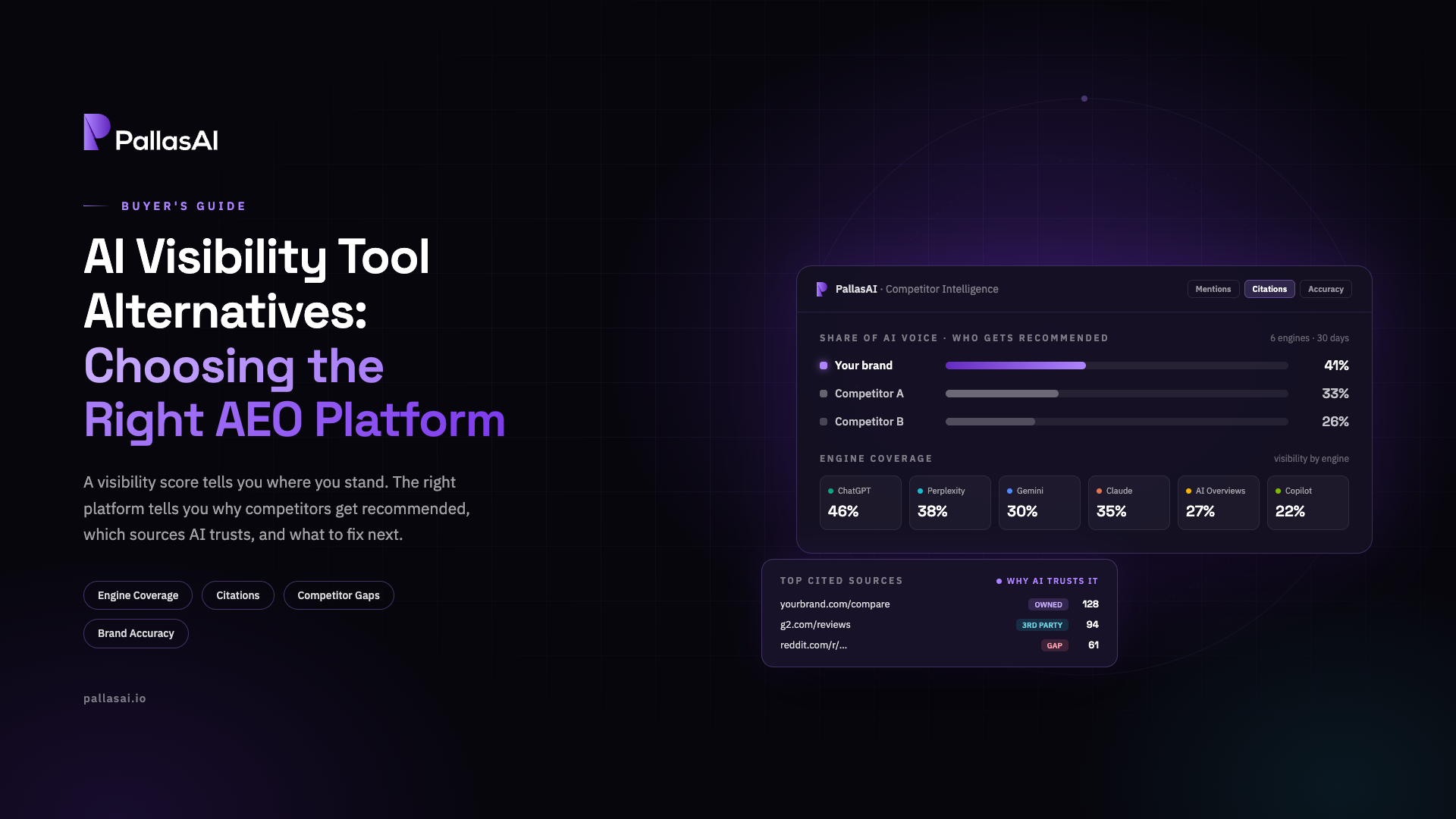
Choosing an AI visibility tool alternative is not the same as shopping for another dashboard.
Most teams start looking because something feels off. They can see a visibility score, but they cannot explain why it changed. They know competitors appear more often in AI answers, but they do not know which sources those competitors are winning from. They see brand mentions, but not citations. They receive reports, but no clear next action.
That is the real reason teams switch AI visibility tools: the old platform shows the problem, but does not help them move the result.
Why companies look for AI visibility tool alternatives
The first trigger is usually pricing. Some platforms become expensive as soon as you need more prompts, more engines, more users, more competitors, or historical data. A cheap starter plan can turn into a poor fit once AI search becomes a real reporting channel.
The second trigger is limited AI engine coverage. If a platform only tracks one or two engines, it cannot show how your brand performs across ChatGPT, Perplexity, Gemini, Claude, Google AI Overviews, Copilot, and other answer environments. AI visibility is fragmented by design. Your tool needs to reflect that.
The third trigger is weak citation data. Mentions are useful, but citations explain why the AI trusted a source. If your tool says you were mentioned but cannot show which pages, reviews, forums, articles, or competitor sources shaped the answer, your team is still guessing.
The fourth trigger is poor competitor tracking. AI search is a recommendation game. The question is not only whether you appear, but who appears instead. A serious AEO platform should show competitor visibility, share of AI voice, topic gaps, and the sources helping rivals get recommended.
The fifth trigger is lack of action. A dashboard that says "visibility is down" is not enough. Teams need to know what to fix: product facts, schema, collection pages, comparison content, third-party mentions, pricing clarity, or outdated brand profiles.
When should you switch from an AI visibility tool?
- Switch when your current platform only shows visibility. Knowing that visibility is low does not tell you what to do next.
- Switch when your platform tracks mentions but not citations. A mention tells you AI noticed the brand. A citation tells you which source earned trust.
- Switch when your platform does not explain competitor gaps. If a competitor appears more often, you need to know whether they are winning through better owned pages, stronger third-party sources, clearer pricing, review coverage, or fresher content.
- Switch when your platform does not track brand accuracy. AI may recommend your product while getting the price, availability, integrations, features, or use case wrong. That is not success. That is risk wrapped in confidence.
- Switch when your platform does not connect insights to actions. Pretty reports are not a strategy. The right tool should help your team decide what to update, what to publish, where to earn citations, and how to measure whether the fix worked.
| What you need | What to look for |
|---|---|
| More AI engine coverage | ChatGPT, Perplexity, Gemini, Claude, AI Overviews, Copilot |
| Better citation intelligence | Source-level citation tracking |
| Competitor intelligence | Competitor mentions, recommendations and share of voice |
| Brand accuracy | Incorrect facts, pricing, product and positioning |
| Ecommerce visibility | Product-level monitoring and recommendations |
| Content execution | Actionable content opportunities |
| Enterprise workflows | API, exports, integrations and reporting |
What to compare when evaluating an AI visibility tool
- AI engine coverage. Check which answer engines the platform tracks and whether it reports performance by engine, not only as one blended score.
- Prompt coverage. The tool should track buyer-intent prompts, competitor prompts, category prompts, product prompts, and long-tail questions. Branded prompts alone are too easy and too misleading.
- Mention tracking. You need to know whether your brand appears at all, but mention tracking is the floor, not the ceiling.
- Citation tracking. Strong platforms show which sources AI engines cite, whether those sources are owned or third-party, and whether the citation supports the claim being made.
- Competitor visibility. Your report should show who AI recommends instead of you, which topics they win, and how their share of AI voice changes over time.
- Brand accuracy. The platform should check whether AI describes your company, products, pricing, availability, features, and positioning correctly.
- Product recommendations. For ecommerce, DTC, and SaaS teams, it matters whether AI actually recommends the product for commercial prompts, not just whether it mentions the brand name.
- Content recommendations. The tool should translate visibility gaps into content opportunities: pages to improve, comparisons to publish, FAQs to add, and external sources to pursue.
- Reporting. Look for reports that separate engines, prompts, citations, competitors, and accuracy. One total score is too blunt for serious AEO work.
- Integrations and API. If your team has a Shopify store, product feed, CRM, data warehouse, or content workflow, the AI visibility platform should fit into the stack instead of becoming another manual export.
How PallasAI fits the alternatives conversation
PallasAI is built for teams that need more than passive monitoring. It audits how AI engines describe your brand, shows where you are skipped or misrepresented, and helps turn those gaps into prioritized fixes.
That matters because AI visibility is not only a measurement problem. It is a workflow problem. Brands need to monitor prompts, understand citations, compare competitors, correct inaccurate brand facts, and publish content that AI systems can read and trust.
PallasAI's approach is especially relevant for Shopify and ecommerce teams because product facts, pricing, availability, collections, reviews, and outdated SKUs can all shape AI answers. Its Context OS helps assemble the right version of the brand, while the Agent workflow turns insights into work instead of leaving another to-do list for the marketing team.
The clean way to evaluate alternatives
Do not ask, "Which AI visibility tool has the prettiest dashboard?" Ask, "Which platform helps us understand why AI recommends competitors, what sources it trusts, what facts it gets wrong, and what we should fix next?"
That question separates generic AI visibility tools from real AEO platforms.
If you are evaluating AI visibility tool alternatives, start with the problem your current tool cannot solve. If the gap is engine coverage, compare coverage. If the gap is weak citations, compare source-level reporting. If the gap is execution, compare recommendations, integrations, and workflow.
The right AEO platform should not just tell you where your brand stands. It should help you become the answer AI recommends.