
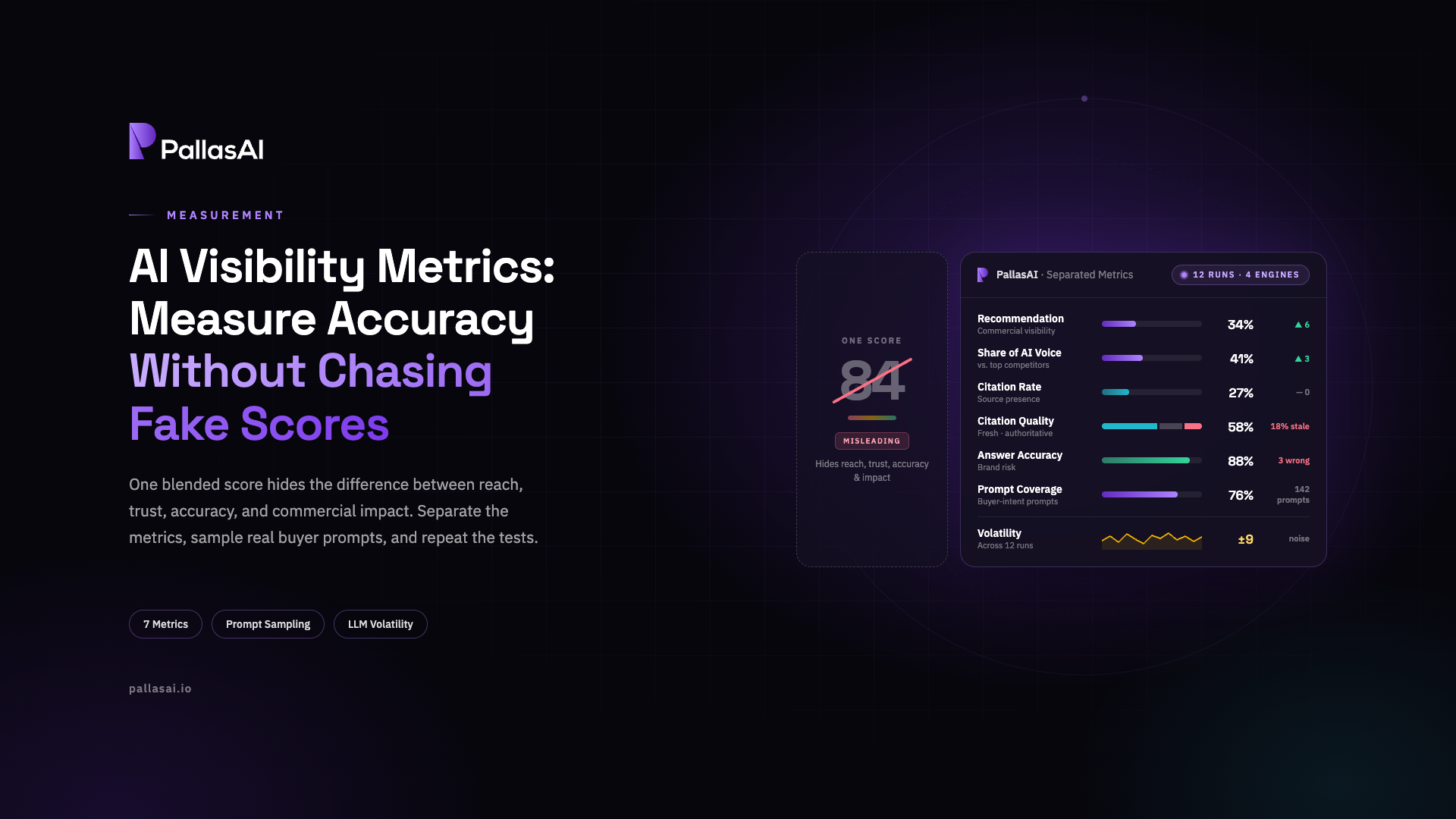
AI visibility dashboards are starting to look dangerously simple. One score. One chart. One green or red number that claims to summarize whether your brand is winning in AI search.
That is comforting. It is also usually misleading.
AI search visibility is not a single metric because AI answers are not single outcomes. Your brand can be mentioned but not recommended. Recommended but not cited. Cited from an outdated page. Described with the wrong price. Included in ChatGPT but missing from Perplexity. Accurate this week and wrong next week.
If your team only watches one AI visibility score, you may optimize for the dashboard instead of the buyer conversation.
Why one AI visibility score is misleading
A blended score hides the difference between reach, trust, accuracy, and commercial impact. For example, a brand might appear in 60 percent of tracked prompts, which sounds strong. But if most of those appearances are neutral mentions, low-quality citations, or outdated facts, the brand is not actually winning.
The reverse can also happen. A niche B2B company may appear in fewer prompts overall but dominate the high-intent prompts that influence the pipeline: "best software for enterprise compliance teams," "alternatives to [competitor]," or "which vendor supports Shopify-native AEO fixes."
A real AI visibility framework should separate the metrics instead of flattening them into one fake sense of certainty.
Core AI visibility metrics to track
Recommendation rate measures how often an AI engine actively recommends your brand for a prompt. This is stronger than a mention because it means the model positioned your brand as a viable answer, vendor, product, or source.
Share of AI Voice is a comparative metric used to measure how frequently your brand appears relative to competitors across the same prompt set. If you appear in 20 percent of answers but a competitor appears in 55 percent, the question is not "are we visible?" It is "why are they being selected more often?"
Citation quality measures which sources AI engines use when they discuss your brand. A citation to your current product page is stronger than a citation to an old blog post, a thin directory, or a third-party page with outdated details. The best reports classify citations by source type, freshness, authority, and whether the cited page supports the claim being made.
Answer accuracy measures whether AI gets the facts right. This includes pricing, features, integrations, availability, product positioning, company description, locations served, and who the product is for. Accuracy matters because a confident wrong answer can cost more than no answer at all.
Prompt coverage measures whether your tracking set reflects real buyer questions. A beautiful score built on weak prompts is just decoration.
How prompt sampling should work
Prompt sampling should start with business intent, not keyword vanity. Build sets around the moments where buyers ask AI for help: category discovery, competitor comparison, pricing research, implementation questions, risk concerns, and final vendor shortlists.
Each prompt set should include variations. Buyers do not ask one perfect query. They ask messy questions with different wording, roles, industries, budgets, and constraints. A strong sample might include ecommerce prompts, SaaS prompts, agency prompts, and competitor prompts separately so the report can show where visibility is actually breaking.
The sample also needs stable tracking prompts and rotating discovery prompts. Stable prompts let you measure trend over time. Rotating prompts help catch new language, new competitors, and new buyer concerns.
How to handle LLM volatility
AI answers change. That is not a bug in the measurement system; it is the thing being measured.
Teams should repeat tests across engines, dates, and prompt variations. Do not treat one run as truth. Track recurring patterns: which engines consistently recommend you, which facts are repeatedly wrong, which competitors keep appearing, and which citations show up across multiple runs.
For reporting, separate one-time anomalies from persistent visibility gaps. A single missed mention is noise. A repeated failure across high-intent prompts is a strategy problem.
What accurate should mean in AI search analytics
Accurate does not mean perfectly predicting every AI answer. No platform can do that because answer engines are probabilistic and constantly changing.
Accurate means the methodology is transparent, the prompt sample is commercially relevant, the tests are repeated, the metrics are separated, and the report distinguishes confidence from noise. It also means the platform checks whether the answer is factually correct, not merely whether your brand appeared.
Example reporting framework for teams
A useful AI visibility report should show:
- Priority prompt groups by buyer intent
- Recommendation rate by engine
- Share of AI voice versus top competitors
- Citation sources, quality, and freshness
- Fact accuracy issues and severity
- Prompts where the brand is skipped entirely
- Pages or third-party sources that need fixing
- Recommended actions ranked by likely impact
That last line matters. Reporting is only useful if it changes what the team does next.
| Metric | What it measures | Why it matters |
|---|---|---|
| Recommendation Rate | How often AI recommends your brand | Commercial visibility |
| Share of AI Voice | Your presence vs competitors | Competitive position |
| Citation Rate | How often your sources are cited | Evidence / source presence |
| Citation Quality | Quality and relevance of cited sources | Trust & accuracy |
| Answer Accuracy | Whether AI gets your facts right | Brand risk |
| Prompt Coverage | Whether tracked prompts reflect buyer intent | Measurement quality |
| Volatility | How much answers change | Reliability of trends |
PallasAI is built for this kind of measurement loop. It monitors how your brand appears across major AI engines, diagnoses where you are skipped or misrepresented, and helps prioritize the fixes that improve recommendation quality and answer accuracy. The goal is not to chase a pretty score. The goal is to make sure AI can read, trust, and recommend the correct version of your brand.
If your team is building an AI search analytics program, start with metrics that match real buyer behavior: recommendation rate, share of AI voice, citation quality, answer accuracy, and volatility over repeated tests. A single score may look clean in a dashboard. Serious teams need the messier truth.