
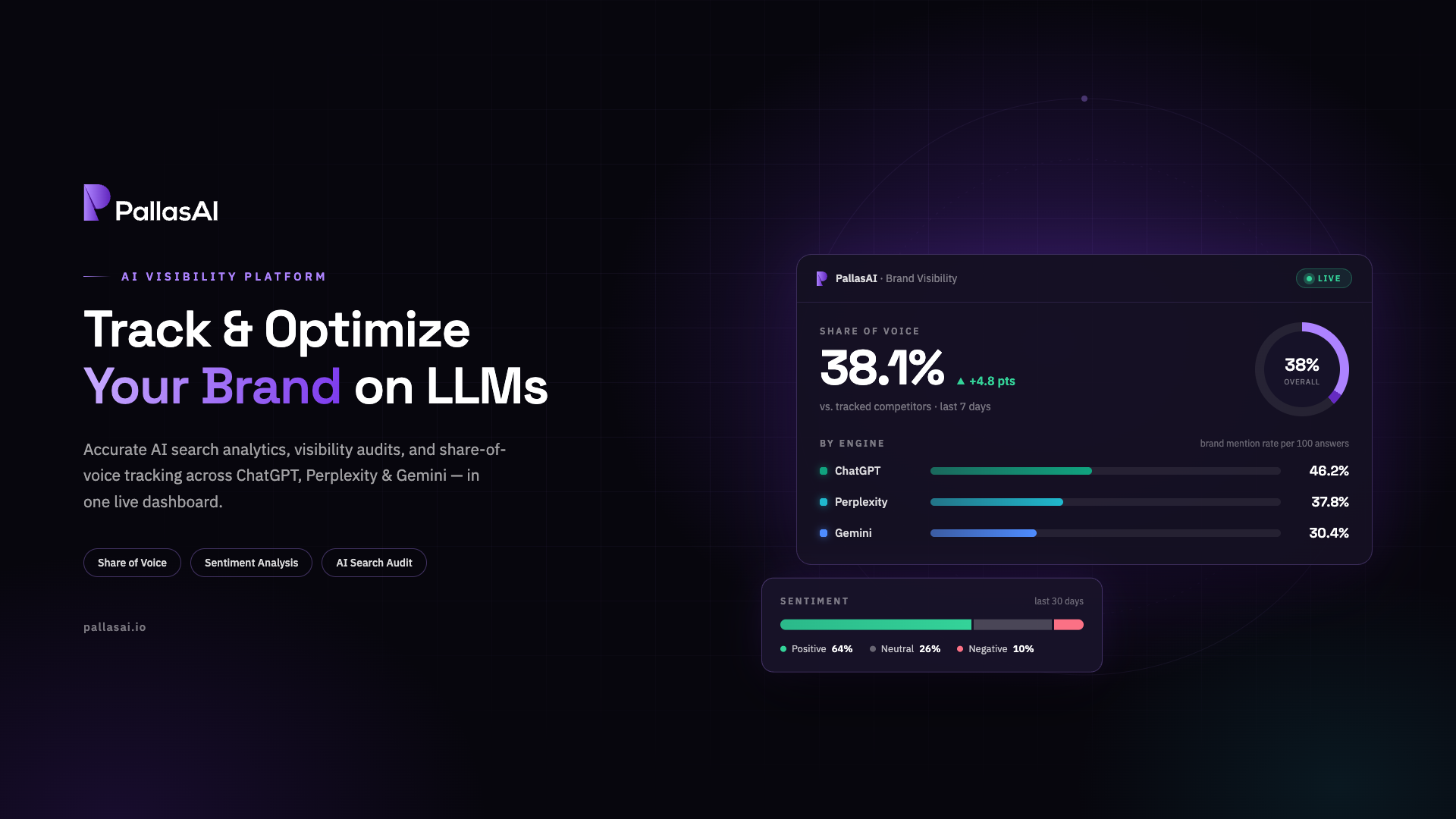
AI visibility measures how often, how accurately, and how prominently your brand appears when people ask AI systems questions related to your category, products, competitors, and use cases.
What Is AI Visibility?
AI visibility is the measurable presence of a brand, product, or entity inside AI-generated answers.
AI visibility therefore covers several distinct questions:
• Is the brand mentioned at all?
• Is it cited as a source?
• Is it recommended relative to competitors?
• Is the description accurate?
• Does visibility change by engine, prompt, topic, market, or time period?
These questions make AI brand visibility broader than a single score. A useful measurement program needs to preserve the underlying evidence so teams can understand why the number changed.
For a broader introduction to this shift from traditional search optimization to answer-engine visibility, see From SEO to GEO: The Complete Guide to AI Search Optimization.
How AI Visibility Differs From Traditional Search Visibility
Traditional SEO visibility is built around ranked search results. A page appears at a measurable position for a keyword, and teams track rankings, impressions, clicks, and traffic over time.
This creates three important differences.
First, prompts are more contextual than keywords. "Best CRM" and "best CRM for a 20-person B2B sales team with HubSpot integration" may produce very different recommendations.
How AI Visibility Is Measured
No single metric fully captures AI visibility. The most useful scorecard combines presence, citations, competitive context, accuracy, and segmentation.
Brand Mention Rate
Brand mention rate measures how often your brand appears across a defined set of prompts.
Segment mention rate by topic, buyer stage, market, product line, and intent. A strong overall average can hide a serious gap in high-value commercial prompts.
Citation Rate
Citation rate measures how often AI answers use or reference your website, product pages, documentation, blog content, or other owned assets as supporting sources.
AI Share of Voice
AI share of voice compares your brand's presence with competitors across the same prompt set.
For commercial prompts, track not only whether a competitor appears but also where it appears in the answer and whether it is actively recommended.
Sentiment and Answer Accuracy
Positive visibility is not useful if the underlying answer is wrong.
Review how AI systems describe your brand, products, pricing model, audience, features, availability, positioning, and limitations. Log inaccuracies as specific claims instead of reducing everything to a single sentiment score.
For example, "AI describes our product as enterprise-only even though we serve smaller teams" is actionable. "Sentiment dropped from 72 to 68" is much harder to diagnose without the underlying answer.
Visibility by Engine, Prompt, and Market
AI visibility should be segmented by the environment in which the answer was generated.
Track results by:
• AI engine
• prompt or prompt group
• topic or use case
• country or market
• language
• buyer stage
• time period
A global average can hide the fact that a brand performs well on one engine but is absent on another, or that visibility is strong in one country and weak in another.
How to Run an AI Visibility Audit
An AI visibility audit establishes a baseline before you start making changes.
Then evaluate the same prompt set across the engines that matter to your audience.
For each answer, capture:
• whether your brand appears
• whether it is recommended
• which competitors appear
• which sources are cited
• whether your site is cited
• whether the description is accurate
• whether important products or use cases are missing
PallasAI's Audit feature is designed around this baseline process, checking whether AI systems can find the brand, recommend it for relevant questions, and describe it accurately across multiple AI platforms.
The first audit should be treated as a baseline, not a verdict. Generated answers vary, so the goal is to identify repeated patterns across a controlled sample rather than react to a single response.
How to Improve AI Visibility
Improving AI visibility usually requires work across technical access, content quality, entity consistency, and third-party authority.
Fix Fetchability
AI systems cannot use content they cannot reliably access.
Teams that need to turn findings into governed work can use the PallasAI AEO Agent to move tasks through monitoring, decisions, action, and review.
Confirm that important pages are crawlable, indexable, rendered correctly, and not unintentionally blocked. Review robots.txt, noindex directives, canonical tags, server responses, JavaScript rendering, and internal linking.
Technical accessibility is not a complete AI visibility strategy, but it is a prerequisite for owned content to compete as a source.
Publish Citable Content
AI systems need clear, specific information that can be extracted and supported.
Strong citable content often includes:
• clear definitions
• comparison criteria
• data with transparent methodology
• product or feature specifications
• implementation guidance
• limitations and trade-offs
• FAQ answers
• original research or first-party observations
The goal is not to write for a machine. The goal is to make genuinely useful information easier for both people and AI systems to understand and reuse.
Strengthen Entity Signals
Your brand should be described consistently across your website and the wider web.
Keep company name, product names, positioning, key attributes, leadership information, locations, pricing language, and major claims consistent wherever they appear. Use appropriate structured data when it accurately reflects visible content.
Internal linking also matters. Connect related pages so the relationship between your company, products, categories, use cases, and supporting content is easy to follow.
Build Third-Party Authority
Owned content alone may not be enough for recommendation-style queries.
Independent reviews, expert coverage, relevant directories, marketplace profiles, industry publications, community discussions, partner pages, and other credible external sources can reinforce how the web describes your brand.
Focus on accurate, legitimate coverage rather than manufactured mentions. The objective is to make important claims verifiable from more than one source.
PallasAI Insights can help teams compare brand and competitor visibility across answer engines, identify repeated source patterns, and find the topics where competitors are being cited or recommended more consistently.
How to Choose an AI Visibility Platform
A useful AI visibility platform should make the measurement process more reliable, not hide it behind a single proprietary score.
Before choosing a platform, evaluate five areas.
• Engine coverage: Does it monitor the AI platforms your audience actually uses?
• Prompt-level evidence: Can you inspect the underlying prompts and generated answers?
• Citation transparency: Can you see which URLs and domains support the answers?
• Competitive context: Can you compare your brand with named competitors using the same measurement scope?
• Actionability: Does the platform help you identify what to fix next, rather than only report visibility?
Also check how the platform handles prompt changes, market segmentation, reporting cadence, data retention, collaboration, exports, and pricing limits.
For a more detailed buying framework, read How to Choose an AI Brand Visibility Platform (2026 Guide).
Frequently Asked Questions
What does AI visibility mean?
AI visibility is the measurable presence of a brand or product inside AI-generated answers. It includes whether the brand is mentioned, cited, recommended, described accurately, and visible relative to competitors across different prompts and AI engines.
How is AI visibility different from SEO visibility?
SEO visibility is primarily based on rankings and performance in traditional search results. AI visibility measures presence and representation inside generated answers, where there may be no fixed ranking page and no guaranteed click to a website.
What is the best way to measure AI brand visibility?
Use a stable prompt set and track mention rate, citation rate, recommendation presence, competitive share of voice, answer accuracy, and visibility by engine, topic, market, and time period. Keep the measurement scope consistent so changes are interpretable.
Can a brand rank well on Google but have poor AI search visibility?
Yes. Strong organic rankings do not guarantee that AI systems will cite or recommend the brand in generated answers. AI visibility depends on the prompt, source set, entity signals, content structure, and the evidence available across the wider web.
How often should AI visibility be monitored?
High-priority prompts can be reviewed regularly, while strategic trends are better evaluated over longer periods. The exact cadence matters less than consistency: use the same prompt scope, engines, markets, and methodology when comparing results over time.
How can I improve brand visibility in AI search?
Start with a baseline audit. Fix crawlability and indexing issues, publish direct and citable answers to high-value buyer questions, strengthen entity consistency, improve internal linking, and build legitimate third-party authority. Then monitor whether mention, citation, recommendation, and accuracy patterns improve.
Build a Repeatable AI Visibility Program
AI visibility is most useful when it becomes a repeatable measurement and improvement process rather than a one-time score.
Define the buyer questions that matter, establish a stable baseline, monitor how your brand and competitors appear, investigate the sources behind those answers, and prioritize the gaps that affect commercial discovery.
Use PallasAI Audit to establish the baseline and PallasAI Insights to track how visibility changes across engines, topics, and competitors over time.