
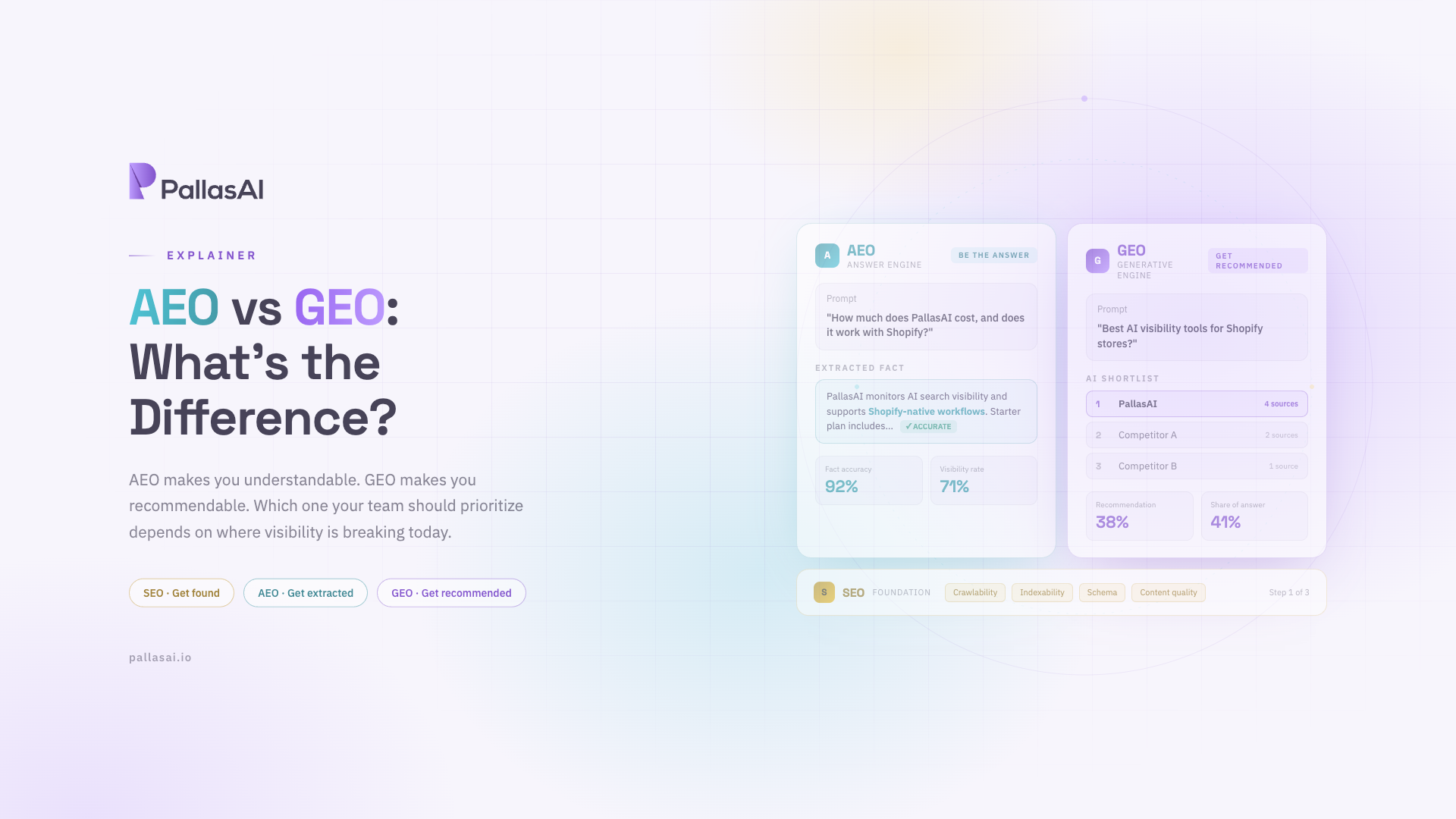
AEO and GEO are often used like they mean the same thing. They are closely related, but they are not identical. The short version: AEO helps your brand become the answer. GEO helps your brand get included, cited, and recommended inside generated answers.
AEO stands for Answer Engine Optimization. It focuses on making your content easy for answer engines to extract as a direct, accurate response. That includes clear definitions, FAQs, product facts, pricing details, comparison tables, schema markup, and pages that answer high-intent questions without forcing a reader to hunt.
GEO stands for Generative Engine Optimization. It focuses on how AI systems synthesize information from multiple sources when they generate a response. GEO is less about one perfect answer block and more about being present in the evidence layer across ChatGPT, Perplexity, Gemini, Claude, Google AI Overviews, and other AI search experiences.
Where SEO still fits
SEO is still the foundation. AI search systems often retrieve information from the open web, search indexes, brand websites, third-party reviews, publisher coverage, community discussions, and structured data. If your pages are blocked, thin, outdated, slow, or poorly structured, you are already behind before AEO or GEO begins.
Think of it this way: SEO helps your content get found. AEO helps your content get extracted cleanly. GEO helps your brand get selected and synthesized into recommendations.
AEO examples
AEO matters most when the AI needs a direct answer. Examples include:
- What does this product do?
- How much does it cost?
- Is this brand available for Shopify stores?
- What is the difference between AEO and GEO?
- Which features are included in the starter plan?
For PallasAI, AEO means making sure answer engines can correctly understand brand facts: PallasAI monitors AI search visibility, diagnoses where brands are skipped or misrepresented, supports Shopify-native workflows, and helps turn visibility gaps into fixes. If AI describes those facts incorrectly, the AEO layer is broken.
GEO examples
GEO matters most when the AI is building a recommendation, shortlist, or comparison. Examples include:
- Best AEO platforms for ecommerce brands
- Top AI visibility tools for Shopify stores
- PallasAI alternatives for AI search optimization
- Should our team prioritize SEO, AEO, or GEO?
- Which AI search monitoring platform is best for agencies?
In these moments, the AI is not just pulling one fact. It is comparing vendors, weighing trust signals, reading third-party mentions, checking consistency across sources, and deciding who deserves to appear in the answer.
The metrics that matter
Traditional SEO teams track rankings, clicks, impressions, and conversions. AI search needs a different scoreboard.
- Visibility rate: how often your brand appears for priority prompts.
- Citation rate: how often AI engines cite your owned pages or trusted third-party sources.
- Recommendation rate: how often your brand is actively recommended, not merely mentioned.
- Fact accuracy: whether AI gets your pricing, features, availability, positioning, and product details right.
- Share of answer: how your presence compares with competitors across the same prompt set.
These metrics matter because AI search can influence buyers even when they never click through to your site.
Which should your team prioritize?
Ecommerce teams should start with AEO. Product facts, collection context, price accuracy, availability, reviews, shipping policies, and discontinued SKU cleanup are high-risk areas. Once the facts are clean, move into GEO by building buying guides, comparison pages, and third-party proof that help AI recommend the brand in shopper prompts.
SaaS teams should usually work on AEO and GEO together. AEO protects product accuracy: features, integrations, pricing, use cases, security, and support details. GEO builds recommendation strength through comparison pages, alternative pages, review presence, category content, partner mentions, and clear positioning against competitors.
Agencies should prioritize GEO first for strategy and reporting, then use AEO to fix client-level gaps. Clients care about whether they show up in AI-generated shortlists, which competitors are being recommended, and what actions will improve that visibility. But the actual fixes often come back to AEO basics: clearer service pages, stronger FAQs, structured content, and consistent brand facts.
The practical priority order
- Start with SEO hygiene: crawlability, indexability, page structure, schema, and content quality.
- Then fix AEO: make the brand, product, pricing, use cases, and claims easy to extract accurately.
- Then scale GEO: earn citations, build comparison content, improve third-party coverage, and monitor recommendation visibility across AI engines.
PallasAI is built around this full loop. It watches how AI engines describe and recommend your brand, identifies where you are skipped or misrepresented, prioritizes the fixes, and helps turn AI search optimization from a manual audit into an ongoing workflow.
AEO and GEO are not rival strategies. AEO makes you understandable. GEO makes you recommendable. The teams that win AI search will need both, but the order depends on the business model, risk, and where visibility is breaking today.