
AI search has changed the job of marketing teams. Ranking on Google still matters, but buyers now ask ChatGPT, Perplexity, Gemini, Claude, and other answer engines for direct recommendations, comparisons, and shortlists. That means your brand does not only need to be discoverable. It needs to be understood, trusted, cited, and recommended.
That is where AEO becomes a marketing strategy rather than another content tactic. AEO is not a one-off content tactic or a new name for SEO. It is a workflow for making your brand easier for AI systems to retrieve, verify, compare, and explain. The goal is simple: when your category, product, use case, or problem space comes up in an AI answer, your brand should appear accurately and in the right context.
What an AEO strategy actually needs to include
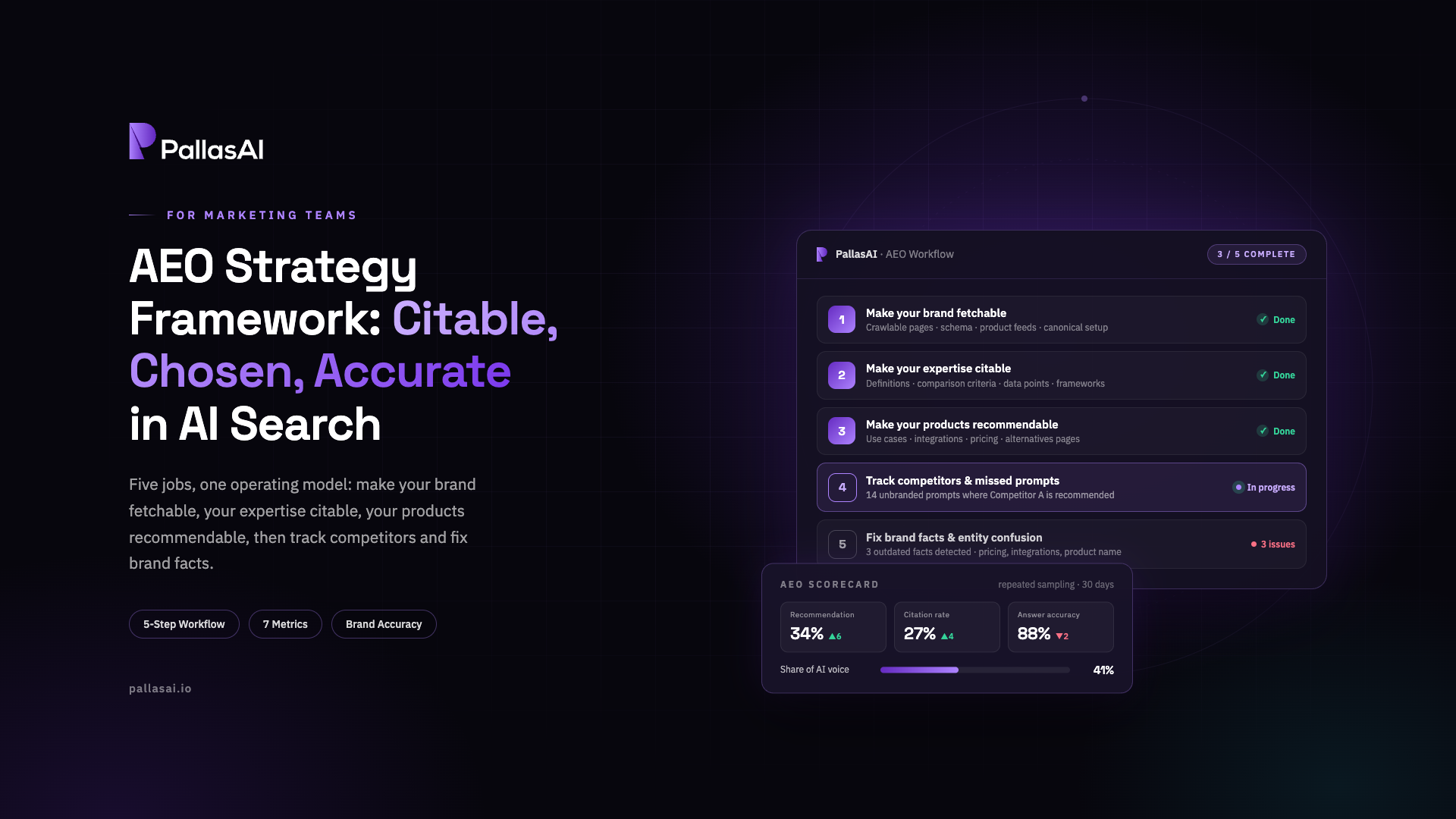
A practical AEO strategy has five jobs. First, make your brand and content accessible to crawlers and answer engines. Second, make your expertise easy to cite. Third, make your products easy to recommend for the right use cases. Fourth, measure where competitors are winning AI answers. Fifth, fix inaccurate or outdated brand facts before they spread across prompts.
This is why AEO should not live only inside the content team. SEO, product marketing, ecommerce, PR, and demand generation all affect the facts and sources that AI systems use. A strong answer engine optimization strategy gives those teams one operating model instead of scattered experiments.
Step 1: Make your brand fetchable
AI systems cannot recommend what they cannot reliably access. Your first AEO layer is technical and structural: crawlable pages, clean internal linking, indexable content, clear schema, consistent product information, and pages that explain who you serve, what you sell, and why you are credible.
This is where traditional SEO still matters. If your pages are blocked, thin, duplicated, slow, or unclear, answer engines have a weak source base. AEO does not replace SEO. It adds another layer of machine-readable clarity on top of it.
For most teams, the fetchability checklist should include robots.txt, sitemap coverage, canonical setup, structured data, product feeds, pricing pages, comparison pages, documentation, author/entity information, and evergreen category content. The point is not to stuff pages with keywords. The point is to make your brand facts easy to retrieve and hard to misunderstand.
Step 2: Make your expertise citable
Visibility in AI answers depends heavily on citations and supporting sources. A brand mention without a citation is useful, but a cited recommendation is stronger because the answer engine is showing why it trusts that source.
To become citable, your content needs more than broad thought leadership. It should include specific claims, definitions, frameworks, examples, comparison criteria, data points, and clear explanations that answer engines can lift into a response. A page that says "we help brands grow" is vague. A page that explains how to measure recommendation rate, citation quality, share of AI voice, and answer accuracy gives AI systems usable material.
Marketing teams should build citation assets around category definitions, buyer questions, comparison criteria, implementation checklists, customer use cases, and problem-specific guides. These assets should link back to your commercial pages, but they should also stand alone as useful references.
Step 3: Make your products recommendable
AEO is not only about being mentioned. The more valuable question is whether AI systems recommend your product when buyers ask for a solution.
That requires clear use-case mapping. Your site should explain which customers you are best for, which problems you solve, which alternatives you compete with, and which workflows your product supports. If those facts are missing or inconsistent, AI systems may recommend a competitor with clearer positioning, even if your product is a better fit.
For SaaS teams, that means strong pages for use cases, industries, integrations, pricing, security, comparisons, and alternatives. For ecommerce teams, it means product feeds, availability, SKU-level details, return policies, reviews, and product attributes that AI shopping experiences can interpret. For agencies, it means service packaging, reporting examples, client workflows, and proof that shows how you measure results.
Step 4: Track competitors and missed prompts
You cannot manage AEO by searching your brand name once a month. Most high-value prompts are unbranded: "best AEO platform for ecommerce," "tools to track AI visibility," "how to improve ChatGPT citations," or "alternatives to my current AI visibility tool." These prompts reveal whether AI systems understand your category and whether competitors are occupying the answer.
AEO teams need competitor tracking across prompt clusters, not just isolated screenshots. Look at which competitors are mentioned, which ones are recommended, which sources are cited, and what reasons AI systems give for choosing them. If competitors win because they have stronger comparison pages, clearer integrations, more third-party mentions, or better structured product facts, that gap becomes your next content or distribution action.
This is where AEO becomes operational. The output should not be a dashboard that says visibility is low. It should show why visibility is low and what to fix next.
Step 5: Fix brand facts and entity confusion
AI systems often mix old facts, outdated pricing, retired products, competitor messaging, or similar brand names. That is not just an SEO issue. It is a brand accuracy problem.
Your AEO strategy should include a source-of-truth layer for brand facts: company description, product names, target customers, categories, integrations, pricing language, founder or team information, policies, locations, and approved positioning. Those facts should be consistent across your website, schema, profiles, product feeds, press pages, partner pages, and high-authority third-party sources.
When AI answers describe your brand incorrectly, the fix is rarely one sentence on one page. You need to identify where the wrong interpretation comes from, update the strongest sources, and monitor whether answers change over repeated tests.
Metrics teams should monitor
The weakest AEO programs chase one visibility score. The better approach is to track separate metrics, each with a clear job.
Recommendation rate shows how often AI systems suggest your brand for relevant prompts. Share of AI voice shows how much of the answer space your brand owns compared with competitors. Citation rate shows whether your brand or content is used as a source. Citation quality shows whether those sources are authoritative, current, and relevant. Answer accuracy shows whether the facts in AI responses are correct. Prompt coverage shows whether you are testing enough of the buyer journey, not just branded queries.
Teams should repeat tests over time because AI answers are volatile. One run is a screenshot. Repeated sampling becomes a signal.
| Metric | What it measures |
|---|---|
| AI Visibility | How often your brand appears |
| Recommendation Rate | How often AI recommends your brand |
| Citation Rate | How often your brand/content is cited |
| Citation Quality | Whether cited sources are authoritative and current |
| Answer Accuracy | Whether AI describes your brand correctly |
| Share of AI Voice | Your visibility compared with competitors |
| Prompt Coverage | Whether your tracked prompts represent buyer intent |
How PallasAI supports the workflow
PallasAI fits into this workflow by connecting monitoring, diagnosis, and action. Teams can track how brands appear across AI engines with AI visibility tracking, see where competitors are winning, inspect citation patterns, find content opportunities, and turn insights into prioritized actions instead of another static report.
For marketing teams, the value is not just knowing whether AI mentions the brand. It is knowing which prompts matter, which citations are missing, which facts are wrong, which competitors are being recommended, and which next actions are likely to improve visibility.
That is the real shift from SEO to AEO. Search strategy used to stop at rankings and traffic. Modern answer engine optimization strategy has to measure whether AI systems can retrieve the right version of your brand, cite trustworthy sources, and recommend you when buyers ask for help.