
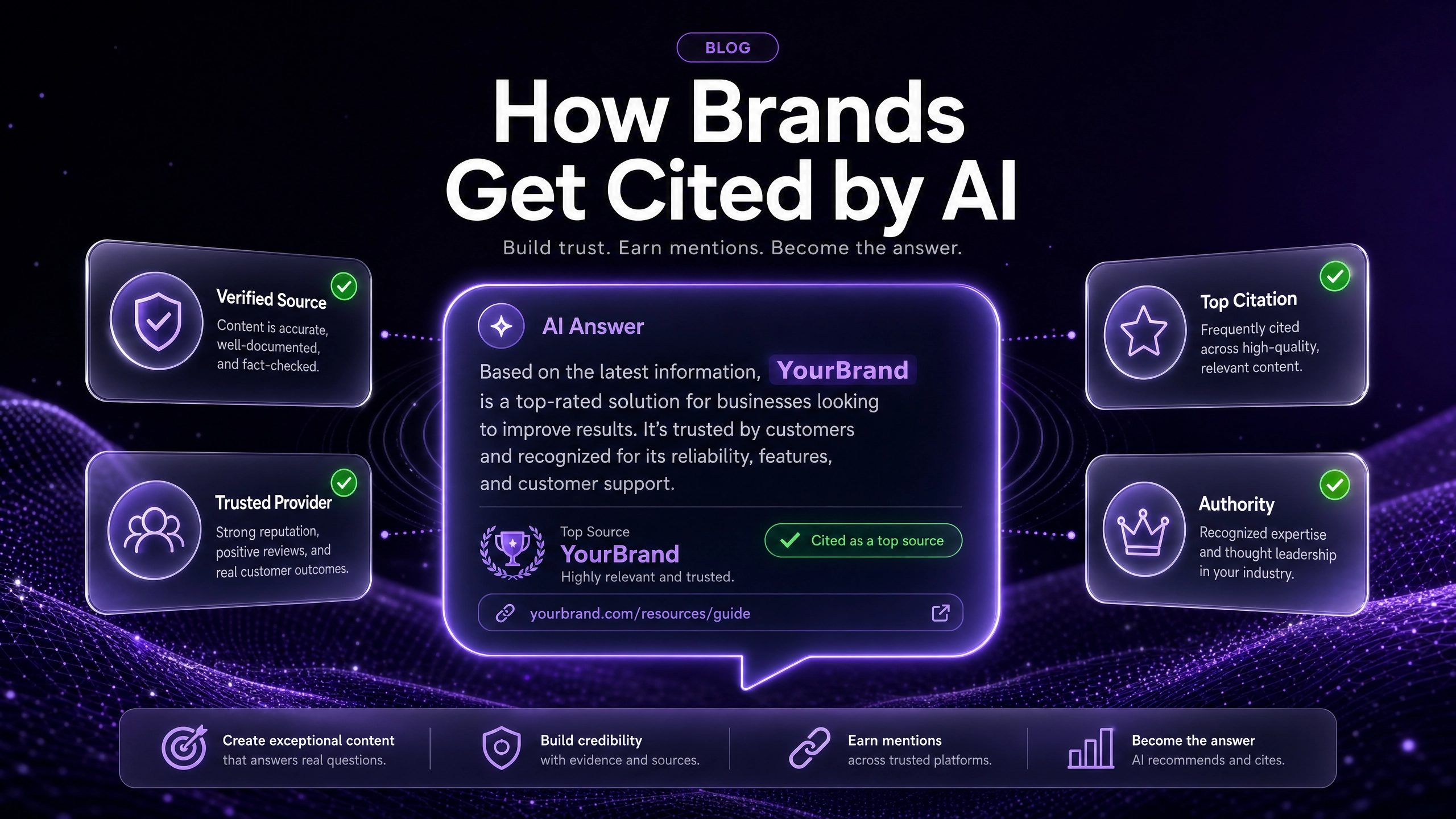
An AI citation is a source link, reference, or attribution that an AI answer experience shows while responding to a user. It is not a guarantee that a model has learned your brand, and it is not a replacement for conventional search visibility. It is one visible signal that a system found a source useful for a particular question.
This guide identifies the seven AI citation mistakes that make a brand harder to select as a source. It then turns the fixes into an operating checklist that content, technical SEO, brand, and PR teams can use together.
Why Brands Fail to Earn AI Citations
Brands rarely disappear from AI answers because of one missing tag or one weak page. The more common issue is a chain of uncertainty. A page may be technically reachable but fail to state the answer plainly. A useful claim may be clear on the company site but inconsistent with the rest of the web. A team may update a launch page while old pricing, positioning, or product details remain on high-visibility pages.
Seven AI Citation Mistakes
Promotional Copy Instead of Direct Answers
A visitor should not have to decode a value proposition to learn what you do, who it is for, or how a process works. Phrases such as “the leading solution” or “a new era of efficiency” may express a brand position, but they do not answer a buyer’s question unless they are followed by verifiable detail.
The goal of AI citation optimization is not to strip personality from every page. It is to separate the claim from the adjectives. Keep your voice, but make the fact discoverable before the flourish.
No Third-Party Corroboration
Owned content is where a company can explain its products accurately. It is not the only place where prospective customers look for evidence. When an answer requires an independent recommendation, comparison, review, market context, or expert perspective, a source ecosystem that contains only your own pages gives readers less material to cross-check.
For a deeper B2B program, see how B2B software can earn ChatGPT and Perplexity citations. It explains the separate roles of entity clarity, external validation, and buyer-question alignment.
Key Facts Buried in Fluff
A strong fact can be functionally invisible when it is buried after a long introduction, spread across several paragraphs, or mixed with unrelated ideas. This is one of the easiest AI citation mistakes to correct because it is largely editorial.
One Strategy for Every AI Engine
It is tempting to run one prompt, see one answer, and treat that result as a score for all AI searches. That approach hides the real problem. Systems vary in their source access, product experience, query interpretation, and update cadence. A change that improves one result may not affect another in the same way or on the same timeline.
Stale Claims and Content
Old facts create two problems. They can mislead readers, and they make it difficult to decide which version of your brand information is current. Pricing, availability, policies, product capabilities, research figures, and named integrations need an ownership model rather than an occasional cleanup.
Poor AI Crawler Access and Structure
Technical access is necessary but not sufficient. Confirm that key public pages return a successful response, are available without a login, expose their important information as text, and are not blocked by robots directives, a CDN, or a web application firewall. Google likewise advises site owners to ensure crawling is allowed, make content findable through internal links, and keep important content in textual form.
Relying Only on Owned Media
Publishing better pages is essential, but it cannot replace the relationships and evidence that live beyond your domain. A buyer evaluating a category may want research, reviews, analyst context, implementation stories, or practitioner discussion. Your content should make your perspective clear, while a responsible external-presence plan expands the places where accurate information can be found.
How to Get Cited by AI After Fixing These Mistakes
Fixing AI citation mistakes works best as a sequence, not a one-time content rewrite. Start with a baseline: document the questions that matter, the engines that matter, your current presence, and the accuracy of the descriptions you receive. Then resolve access barriers and contradictory core facts before expanding content or outreach.
Teams that need to turn findings into governed work can use the PallasAI AEO Agent to move tasks through monitoring, decisions, action, and review.
If the diagnosis shows a broader discovery problem, use this guide to fix AI search visibility before chasing individual citations.
AI Citation Readiness Checklist: Avoiding AI Citation Mistakes
| Area | Question to review | Practical evidence of readiness |
|---|---|---|
| Core answer | Does the first part of each important section answer one real user question? | A reader can identify the answer, scope, and next step without interpreting marketing language. |
| Claim quality | Can each material claim be traced to an approved source? | The team can locate the documentation, research, policy, or owner behind the statement. |
| Freshness | Are time-sensitive pages reviewed when underlying facts change? | Important claims have an owner and a next review date. |
| Access | Can relevant crawlers and users reach the canonical public page? | No unintended robots, rendering, login, or infrastructure barrier blocks the content. |
| Structure | Is the important content available as clear text under meaningful headings? | Sections, tables, and lists make the topic and answer easy to locate. |
| Corroboration | Can readers find accurate, independent context where it matters? | Relevant listings, publications, reviews, or community contributions are authentic and current. |
| Measurement | Is performance checked across a repeatable set of questions? | The team records inclusion, accuracy, cited sources when shown, and changes over time. |
If the content work is the bottleneck, PallasAI’s AEO Content Assets workflow focuses on drafts grounded in verified brand context and reviewed before publication. Whatever tool you use, preserve human review for pricing, specifications, legal claims, comparisons, and any statement that could change a buying decision.
How to Diagnose Citation Gaps
A useful diagnosis separates four failure modes. Reachability asks whether the system can access the correct page. Extractability asks whether the page states the answer clearly enough to use. Accuracy asks whether the facts are current and consistent. Corroboration asks whether the wider information environment gives a reader a reason to trust or compare the claim.
Frequently Asked Questions
What are the most common AI citation mistakes?
The most common AI citation mistakes are promotional copy with no direct answer, unsupported or inconsistent claims, key facts hidden in long sections, stale information, blocked or difficult-to-parse public pages, a single measurement approach for every engine, and an overreliance on owned media. Start by identifying which of these conditions affects the specific customer question you want to answer.
How do AI citation mistakes keep a site out of ChatGPT Search?
AI citation mistakes can remove either access or usefulness. For ChatGPT Search, confirm that OAI-SearchBot is not unintentionally blocked, then examine whether the accessible page gives a factual, well-scoped answer that is current and relevant to the query. OpenAI states that sites opted out of OAI-SearchBot will not be shown in ChatGPT search answers, although permission alone does not guarantee inclusion.
Can technical fixes alone resolve AI citation mistakes?
No. Technical fixes can remove barriers, but they do not make vague content specific, reconcile conflicting product information, or create independent evidence. Treat crawlability, answer quality, factual accuracy, and corroboration as separate checks. Solve the first failing condition, then retest the same question.
How can I get cited by AI without rewriting every page?
Start with pages that influence a high-value decision: core product pages, pricing or policy pages, category explainers, comparison pages, and frequently referenced help content. Audit those pages for direct answers, supported claims, freshness, access, and internal discovery. A small set of corrected, well-governed pages is more useful than a large volume of loosely targeted articles.
Why won’t AI cite my website after I update it?
An update may have fixed only one part of the problem. Check whether the relevant page is accessible, whether the answer matches the user’s question, whether older versions of the claim still exist elsewhere, whether independent context is missing, and whether the engine has had time to discover the change. Compare the same prompt over time and document the precise gap rather than assuming every system updates at the same pace.
Make Your Brand Easier to Verify
The goal is not to make every page sound like a database entry. It is to make your best information easy to understand, verify, and maintain. Address the AI citation mistakes that create ambiguity first: inaccessible pages, unsupported claims, buried answers, and stale facts. Then use measurement to determine which questions and sources deserve the next investment.